
Ebb Ogham 85v
Organic Communication and Knowledge

The inner circle starting at 9 o’clock.
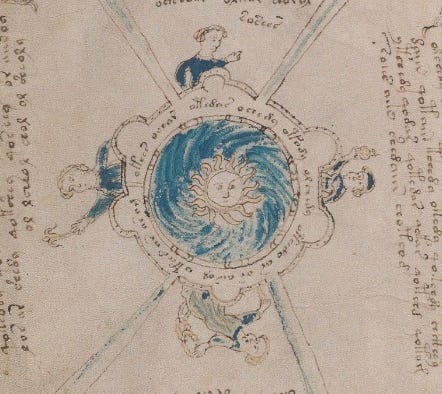
Maturing tiny woman later descendant *in the North to counsel, advise a small length (for) them to read lines (ropes) here woven fabric **Athenian***organic
*in the North could be phonetically translated to small amount of time.
**Connotation for Athenian is: Wise Knowing. Word as written, sounds more like the word for churl, meaning peasant.
***Organic could be translated to golden eight, possibly having to do with the seven sisters reference or the segments of four in the image each having a double meaning as the text reads.
Overlap between script lines and rope. There is a notable visual and auditory overlap between the words Ogham and Oakum.
There is an overlap between musical reed and the word read.
The theme of filtering repeats here as well. As we see in the Alkali cycle and several points in the natal sections, description of filtering. Like the processes depicted and explained, the language has also gone through some kind of filtering. A reduction and condensation. A linguistic resin or medicine, so to speak. Here in the center of these four individuals, we have a drain, with Ogham ebbing, leaving behind only “what is needed”(73v)
Middle English reden, ireden, “to counsel, advise,” also “to read,” from Old English rædan, gerædan (West Saxon), redan, geredan (Anglian) “to advise, counsel, persuade; discuss, deliberate; rule, guide; arrange, equip; forebode; to read (observe and apprehend the meaning of something written), utter aloud (words, letters, etc.); to explain; to learn through reading; to put in order.”
We have the themes large and small scale and the theme of musical instrument.
eang, f. (gs. ~a, pl. ~aí). 1. Track, trace. Dul ar ~ ruda, to track sth. Lean siad ~ na sinsear, they followed in the footsteps of their ancestors. ~ in ~, step by step; one after another. 2. (a) Inset, gusset. ~ a chur i mball éadaigh, to insert a gusset in a garment. (b) Angle, corner; piece, strip. ~ idir dhá abhainn, a (narrowing) strip between two rivers. ~ talún, patch of land. Ar ~ línéadaigh, on a piece of linen. San ~ tíre seo, in this corner of the country; in this district. 3. Notch; nick, groove.
aibigh, v.t. & i. (vn. -iú m, gs. -ithe). Ripen, mature.
eireog, f. (gs. -oige, npl. ~a, gpl. ~). 1. Pullet, chicken. 2. Young girl; tiny woman. (Var:éireog1)
small - og
iaró, m. (gs. ~, pl. ~í; dpl. form ~ibh often used as npl). 1. (Later) descendant.
og small
atha1, f. (gs. ~). Space of time. I gceann ~, after a while. ~ fhada, a long while. Le h~, for some time.
(a)thuaidh, adv. & a. 1. (In the) north.
aeradán, m. (gs. & npl. -áin, gpl. ~). Air-tube.
Middle English reden, ireden, “to counsel, advise,” also “to read,” from Old English rædan, gerædan (West Saxon), redan, geredan (Anglian) “to advise, counsel, persuade; discuss, deliberate; rule, guide; arrange, equip; forebode; to read (observe and apprehend the meaning of something written), utter aloud (words, letters, etc.); to explain; to learn through reading; to put in order.”
fad, m. (gs. & npl. faid, gpl. ~). Length; distance, duration, extent.
them
readán, m. (gs. & npl. -áin, gpl. ~). Reed, pipe.
téad, f. (gs. téide, npl. ~a, gpl. ~). 1. Rope. (a) ~ a theannadh, a scaoileadh, a ligean, to tighten, loosen, let out, a rope. ~ ualaigh, rope for securing load. ~ rite, tight-rope. (b) ~ ancaire, cable (of anchor). ~ cheangail, lashing, tie. ~ cheathrún, stern-fast. ~ chrua, hawser. ~ ghraidhpe, bowline. ~ stiúrach, tiller-rope. ~ taca, stay. ~ tíre, ~ róid, mooring-rope. ~ tarraingthe, tow-line. Bád a tharraingt ar cheann téide, to take a boat in tow. ~ tógála, heaving-line. (c) ~ choirc, top-rope (of net). ~ teachtaireachta, (diver’s)life-line. (d) Tether. Bó a chur ar ~, to tether a cow. Tá sé ar ~ aici, she has him on a string. Tabhair fad a théide dó, give him plenty of rope. 2. String, chord.
teadra - ropes /cordage
óg2, a1. Young.
ag - at/here
uige, f. (gs. ~, pl. -gí). 1. (a) Woven fabric, web. Prov: Gach ~ mar a hábhar, like father like son. (b) Thin, transparent, fabric; tissue, gauze. ~ chadáis, cotton tissue. ~ mhiotail, metal gauze. (c) Tchn: ~ (cheangail), web. 2. Lit: Composition, poem.
Old English ceorl “peasant, one of the lowest class of freemen, man without rank,” from Proto-Germanic *kerlaz, *karlaz (source also of Old Frisian zerl “man, fellow,” Middle Low German kerle, Dutch kerel “freeman of low degree,” German Kerl “man, husband,” Old Norse karl “old man, man”).
aitheach, m. (gs. & npl. -thigh, gpl. ~). 1. Lit: Rent-payer. 2. Churl. 3 = FATHACH.
Aithneach1, m. (gs. & npl. -nigh, gpl. ~) & a1. Athenian.
aithneach2, a1. Quick to recognize, discerning; knowing, wise.
órga, a3. Golden. S.a. RÉALTÁN 2, RIASCBHLÁTH.
virgin(n.)
c. 1200, “unmarried or chaste woman noted for religious piety and having a position of reverence in the Church,” from Anglo-French and Old French virgine “virgin; Virgin Mary,” from Latin virginem (nominative virgo) “maiden, unwedded girl or woman,” also an adjective, “fresh, unused,” probably related to virga “young shoot,” via a notion of “young” (compare Greek talis “a marriageable girl,” cognate with Latin talea “rod, stick, bar”).
The meaning “young woman in a state of inviolate chastity” is recorded from c. 1300. Also applied since early 14c. to a chaste man. The meaning “naive or inexperienced person” is attested from 1953.
organacht - virginity
orgánach1, m. (gs. & npl. -aigh, gpl. ~). Organism. ~ táirgthe, producer organism.
orgánach2, a1. Organic.
“a fusion of late Old English organe, and Old French orgene (12c.), both meaning “musical instrument,” both from Latin organa, plural of organum “a musical instrument,” from Greek organon “implement, tool for making or doing; musical instrument; organ of sense, organ of the body,” literally “that with which one works,” from PIE *werg-ano-, from root *werg- “to do.”